My Commitment
By becoming an educator, I have committed to lifelong learning for myself, and through this module, I was able to expand my knowledge of something that is ever-evolving in our world and unique to each person: learning.
Known Understanding
Diving into all the principles of the cognitive theory of multimedia had me all over the map. Some principles felt like common sense, while others had me recalling all the times I could have fine-tuned my lessons a touch more to avoid extraneous cognitive load.
Connecting to three cognitive science principles, we are taught throughout the education program that learners have a limited capacity and that overloading them leads to inefficient and ineffective learning. This has also become abundantly clear through my own experiences as a student in grade school and post-secondary. That said, I have learned some strategies to avoid this as an educator, as shown in the table below:
| Instructional Design | During Instruction | Visual Design | Student Support |
| One learning target per lesson | Visual cues | Not overloading text | Frequent checks for understanding |
| Segmenting | Learning partners | No decorative images | Guided practice before independent work |
| Limit new vocabulary | Allowing process time | Bold/highlight key information only | Examples and templates |
| Designing assessment before planning activities | Using established routines | One visual per concept | Highlighted task demands |
New Understanding
Meanwhile, understanding four principles from Mayer’s Theory to Reduce Extraneous Cognitive Load made me rethink some of my lessons. Understanding each principle in detail made me reflect on my own experience as a learner in grade school, when much of my learning was through repetition, like using flashcards for a biology test, memorizing a multiplication chart, or Spanish verbs. In reality, that information didn’t fully sink in. It never entered the active processing stage and remained surface-level understanding just to get me through a test.
As a teacher, I would often repeat terms over and over in presentations, hoping the learners would engrain them in their brains. In reality, some of the biggest lesson wins came from giving students choice in studying new concepts. For example, offering a variety of options for retention, such as writing a rap song using vocabulary, drawing a mind map in groups, creating a presentation or mini-movie, or anything that required filtering information meaningfully and applying it in a chosen medium.
Another point I am guilty of is not resisting the urge to share interesting “add ons” that sometimes veer off-topic. One of the greatest joys of teaching is connecting with students, but I have definitely gone off track with only semi-related stories. Sometimes a story enhances a lesson, while other times it causes confusion or backtracking. For example, during an evolution unit, I told the class about a natural selection lab at the end of the unit because I was excited and wanted them to share my excitement. Somewhere along the way, students developed the idea that organisms could adapt on command to survive. Needless to say, I have become better about sharing unit plans without the confusion.
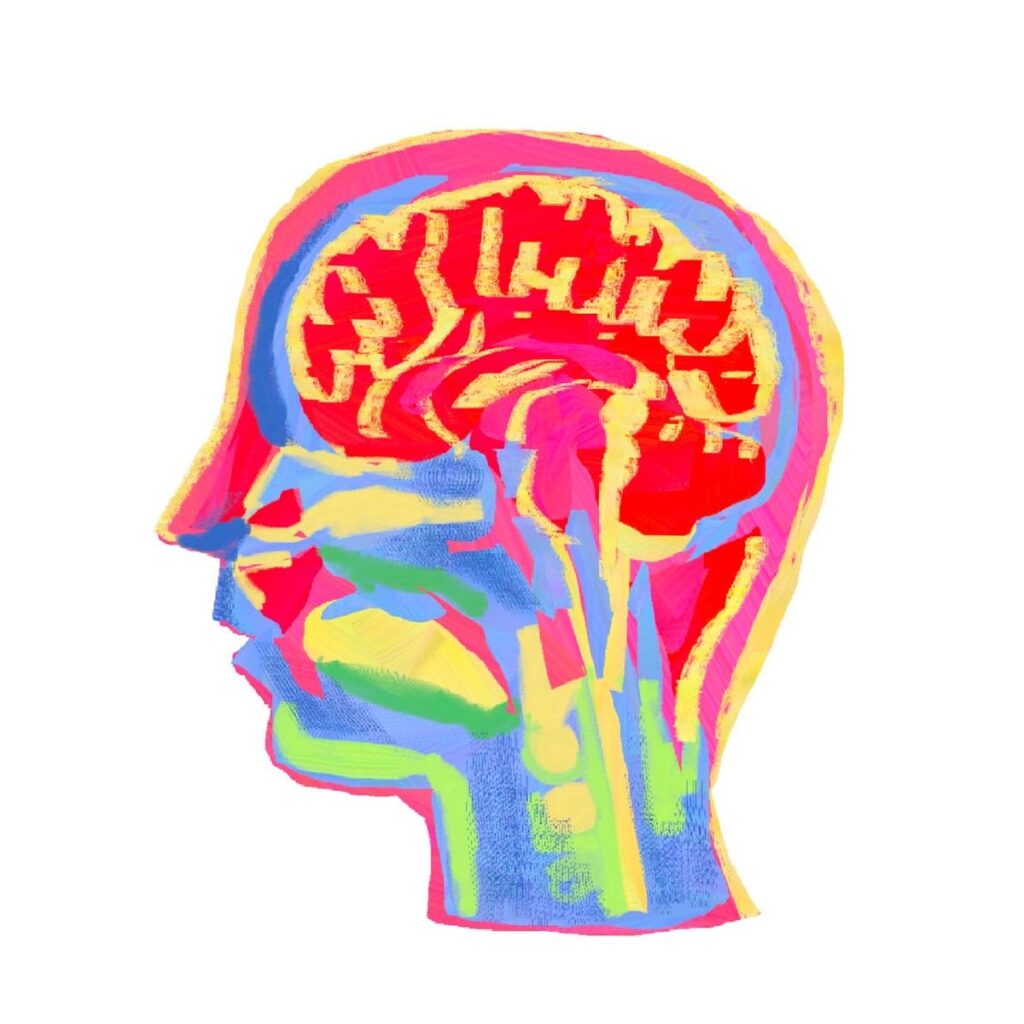
Image source: Pinterest. Link to pin
Using the Tools, Not the Tactics
In recent years, I’ve started to notice how social media affects my focus and well-being. It’s an incredible tool that teaches, connects, and entertains, but its intentionally addictive design has real consequences. Around one-fifth of users report lost sleep, less physical activity, or trouble concentrating, and many feel anxious or frustrated because of their use (Statistics Canada, 2021). Seeing this makes me more intentional about how I use it, and importantly, how I use its tools carefully in an educational setting.
As mentioned in the module, it is no wonder memes are so popular, with their combination of text and fitting images. Memes have helped me in multiple lessons to engage learners and share content. Social media’s use of algorithms to curate the best experience for users can be compared to a teacher shifting a lesson to better suit learners. Unlike doomscrolling, which traps users in a stress loop, human attention in learning has purpose, connecting ideas and making sense of information.
While social media has done wonders at capturing attention, some of its methods can be transferred positively to an educational setting, such as using Allan Paivio’s theory of dual coding, which highlights how two parts of our brain process images and language separately. However, it is crucial to make sure that any tactics borrowed from social media do not carry harmful aftereffects, like cognitive overload, anxiety, or addictive patterns, and are instead used intentionally to support meaningful learning.
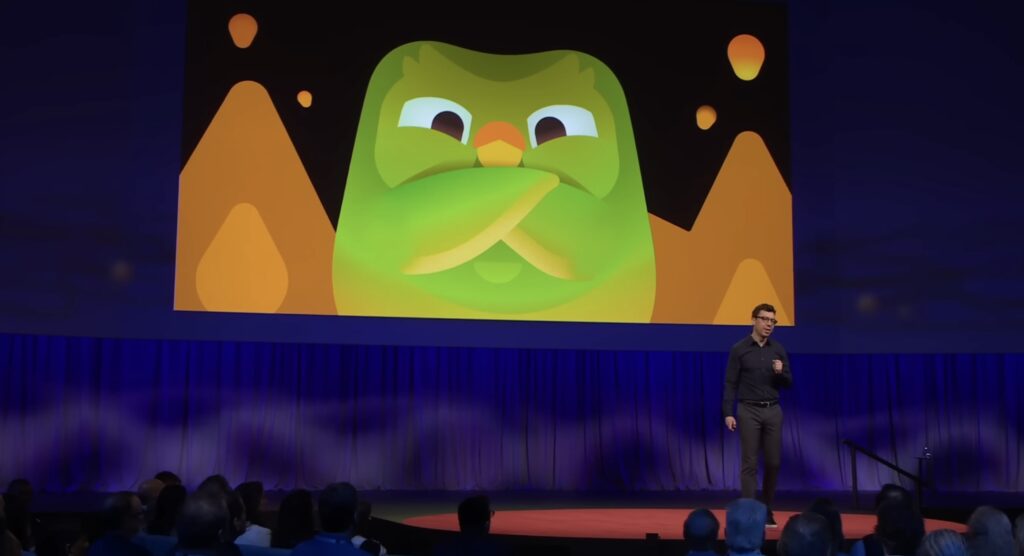
Check out this video below (by clicking on the photo) to see how social media-style design can make learning fun, like Duolingo’s streaks and points. It can be motivating but also a little addictive. How could we use these ideas in education without it becoming overwhelming?
Closing Thoughts
This module has reminded me that learning isn’t just different for everyone, it can be understood and strengthened through using cognitive principles. Social media shows how attention can be captured, but in education we have to use tools with care to ensure the learners are engaged without facing overwhelm.
Leave a Reply