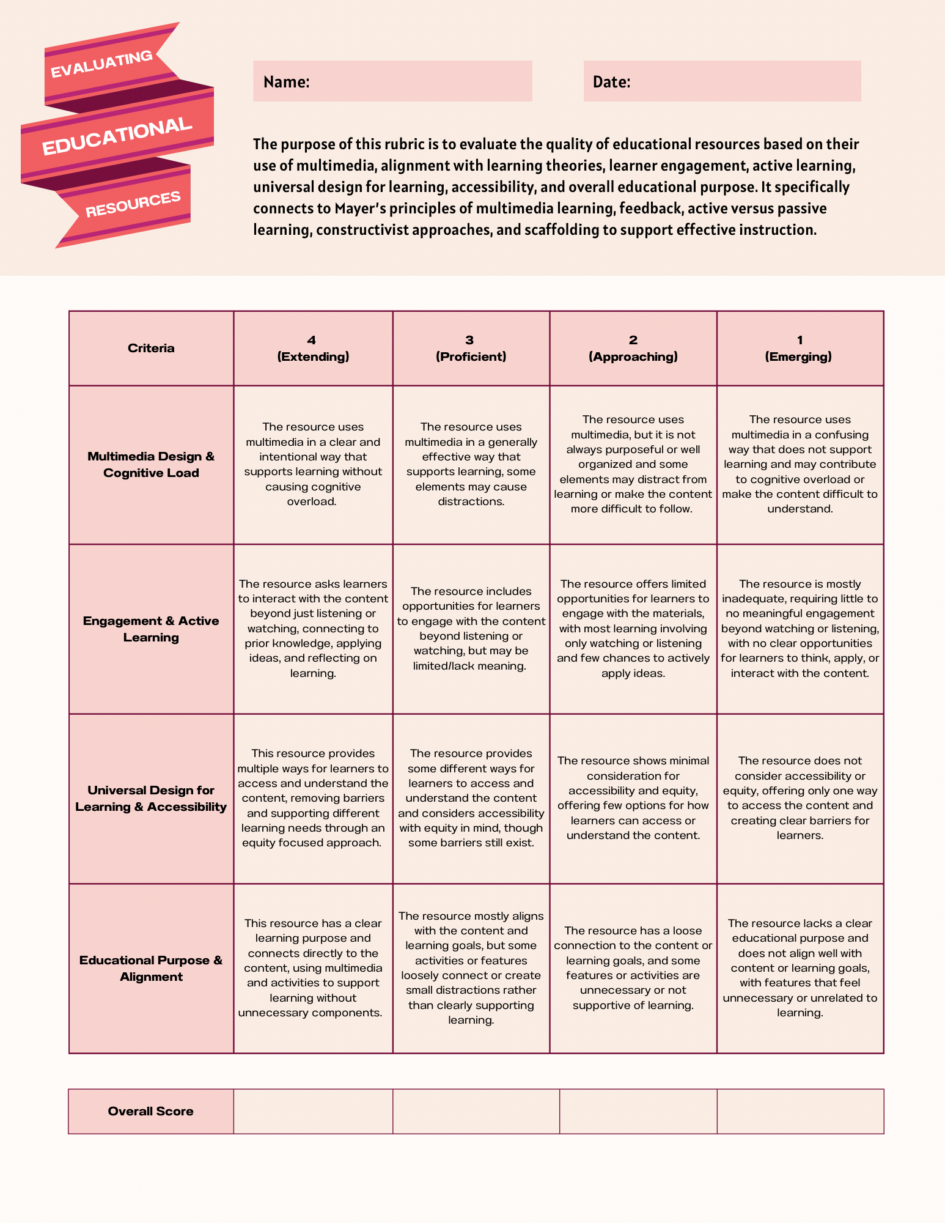
Extending/Proficient Resource – Khan Academy
Khan Academy is an excellent educational tool that connects well with all the criteria provided in the rubric list. The multimedia is clean and thoughtfully utilized on this website, which avoids cognitive overload in the videos by providing clear explanations instead of a lot of visual content. Most videos are whiteboard style with spoken content, which helps the learner understand the content properly without sparking confusion or overwhelm. The learner can also use subtitles, transcripts, and a highlight and speak option on these videos.
The layout is easy to read and follows a logical structure with clear headings and integrated text that continues to focus on the learning outcome. Videos are separated from text, yet they are used together to allow a learner to pick how they want to consume the information available. Khan Academy courses, like the careers one, are differentiated into smaller sections to prevent cognitive overload and promote scaffolding. Some connecting diagrams are embedded with the text.
In terms of active learning, it is clear that the Khan Academy highly values it, since it provides immediate feedback through its quizzes for every section. It allows time for learners to think and try out problems before they are solved for them. The learners can also track their own progress or revisit previous lessons. The feature of adding classrooms and teachers has proven to be practical and useful in a learning environment. The comments section can also encourage learners to interact with each other, adding more learning interactions and engagement.
| Multimedia Design & Cognitive Load 3/4 | Khan Academy uses focused multimedia like whiteboard style videos and clear narrations. This supports learning without causing cognitive overload. Videos are chunked, paired with text, and avoid unnecessary elements that cause distraction. |
| Engagement & Active Learning 4/4 | Learners are asked to actively engage in videos with pauses to try problems, quizzes with immediate feedback, and course progress tracking. This encourages Merrill’s principles of thinking, application, and reflection rather than passive watching. |
| Universal Design for Learning & Accessibility 4/4 | The resource offers subtitles, transcripts, highlight-to-speak options, and flexible pacing, which allows learners multiple ways to access content with equity in mind. These features remove barriers and support diverse learning styles |
| Educational Purpose & Alignment 4/4 | All content is clearly aligned with learning goals, and multimedia elements directly support instruction without unnecessary overload. There is strong scaffolding and structured units to support a meaningful learning process. |
Khan Academy – Final Score: 15/16
Developing Resource – National Geographic Kids
National Geographic Kids provides interesting content but falls under the criteria of the rubric as a moderate-level educational resource. National Geographic Kids has a variety of multimedia elements, but its layout is cluttered with small font, too many colours, and multiple visual features that learners will find difficult to concentrate on because of cognitive overload.
Some sections, such as the pages dedicated to animals, appropriately utilize multimedia resources. These pages present maps of where to locate animals, videos, highlight quality images, and ID cards with detailed characteristics. These elements assist in understanding concepts appropriately through representation. However, not all pages on the site utilize multimedia without creating clutter.
Interactive features like quizzes, personality quizzes, puzzles, and fill-in-the-blank exercises are also present but seem to be targeted towards entertainment more than education. Information is scaffolded and presented in an appropriate manner. However, it seems there are fewer chances to actually engage with the material. Relevant content is present but lacking in active learning engagement opportunities. Overall, it seems that National Geographic Kids has useful information and can be visually engaging but is missing multiple other aspects to be a strong learning resource.
| Multimedia Design & Cognitive Load 2/4 | While the site includes videos, images, and text, the busy layout, bright colours, and small text may create cognitive overload and make it difficult for learners to focus on key information. |
| Engagement & Active Learning 3/4 | The resource includes quizzes, puzzles, and interactive components, but there is a greater focus on entertainment rather than deeper thinking or application. Engagement is present, but active learning may be limited. |
| Universal Design for Learning & Accessibility 2/4 | Some pages provide multiple ways to access information, like videos, text, and visuals, but accessibility supports are not consistent and may create barriers for learners. |
| Educational Purpose & Alignment 2/4 | Certain sections, like the animal profiles use multimedia effectively. However, this alignment is not consistent across the site. Limited to no learning goals offered. |
National Geographic Kids – Final Score: 9/16
Emerging Resource – Kahoot
Kahoot usually creates high energy in the classroom, but it can cause cognitive overload. The vibrant colours, music, timers, and fast-paced nature of the game can be distracting and take away from the content. Questions are usually short and lacking explanations. Which, in turn, encourages students to focus on speed rather than understanding. Because of this, the multimedia aspects do not always support learning or allow process time.
Kahoot also offers limited support for active learning and accessibility. Learning is mainly based on quick responses, which creates barriers for learners who need more time or different ways to express their understanding. Space for feedback is limited or shows correct or incorrect answers only. This leaves little opportunity for reflection or scaffolding. While Kahoot can work as a review or engagement tool, it lacks equity, deep learning, or a clear instructional purpose when used independently.
| Multimedia Design & Cognitive Load 1/4 | Kahoot uses bright colours, music, timers, and fast transitions, which may be distracting and overwhelming for learners. These multimedia elements do not support different learning paces and may contribute to cognitive overload. |
| Engagement & Active Learning 1/4 | While Kahoot is seemingly engaging, most learning interactions are limited to rapid answers selection. Learning is focused on speed rather than thinking. This makes few opportunities for reflection, application, or deeper understanding. |
| Universal Design for Learning & Accessibility 1/4 | The speed based setting creates barriers for many learners, especially those who need more processing time or alternative ways to show understanding. There are limited accessibility options, and equity is not strongly supported. |
| Educational Purpose & Alignment 1/4 | Kahoot lacks a clear instructional purpose when used on its own and is best brought into an educational setting for brief review rather than an attempt towards active learning. The features have a high entertainment focus rather than supporting learning goals. |
Kahoot – Final Score: 4/16
References
Kahoot! (n.d.). Kahoot! https://kahoot.com
Khan Academy. (n.d.). Khan Academy. https://www.khanacademy.org
National Geographic Kids. (n.d.). National Geographic Kids. https://kids.nationalgeographic.com
Leave a Reply