When multimedia is used purposefully and does not cause cognitive overload, it can serve an educational environment in a variety of ways. Using it as a tool to help learners activate prior knowledge at the beginning of a lesson has helped me:
- Engage learners
- Help learners recall information from a previous lesson
- Open up the lesson for active learning
This week’s educational frameworks further support my understanding of multimedia’s place in education and how to use it appropriately.
Lesson Design Based on Merrill’s Principles
Merrill’s Principles explain that people learn best when they are solving real problems that require engagement rather than just listening. This is not to say that learning opportunities that rely on active listening do not have a place in education, but rather that learning which activates multiple areas of the brain also needs to be present in the learning environment. When I think about this, I am reminded of my years in grade school and the poster that many of my teachers had showing the different parts of the brain that are activated when engaged in:
- Reading
- Writing
- Listening
- Coaching/teaching
My grade seven teacher would constantly refer back to this poster to help us understand that sometimes reading or making notes was not enough to study for a large unit test. Instead, we were often tasked with going home and teaching our parents as part of our homework.
Merrill’s Principles prove to be a strong framework that supports learning outcomes through its structure of:
- Problem which involves a real problem that is engaging to the learner
- Activation which involves recalling prior knowledge and bringing it into new ideas and understandings
- Demonstration such as a teacher working through an example
- Application where learners apply their new knowledge
- Integration where learners integrate their new knowledge into the real world
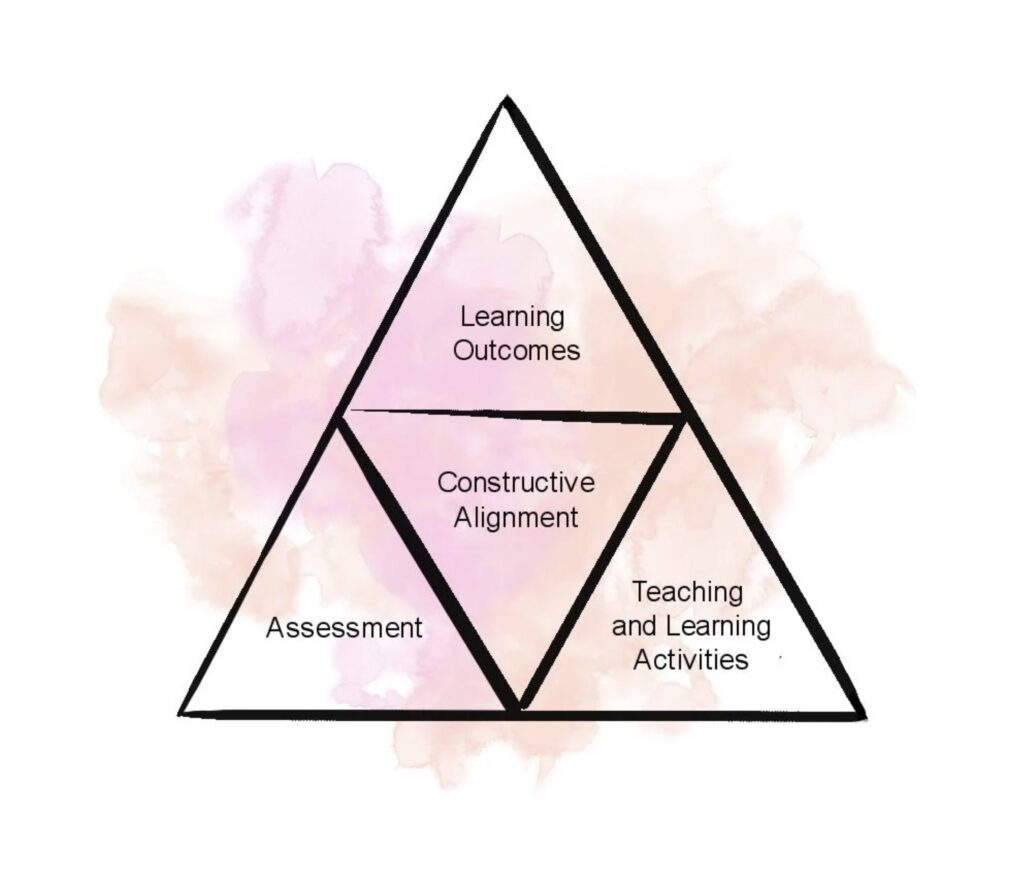
Constructive Alignment in EDCI 337
This course uses constructive alignment and backward design in multiple ways. This is most evident in the learning outcomes and resources, which clearly connect to the course material. The substantive posts require us to apply ideas rather than simply regurgitate information. It is satisfying to learn new principles and then see them in action within this learning environment. In other courses I have taken, alignment has been weaker, with activities that did not connect clearly to assessment or learning outcomes. This often left my peers and me feeling lost in both the content and the overall direction of the course.
Leave a Reply